
Government technology can help services work faster — but when an algorithm gets something wrong, a real person can lose money, face enforcement, wait longer for support or spend months trying to correct a record.
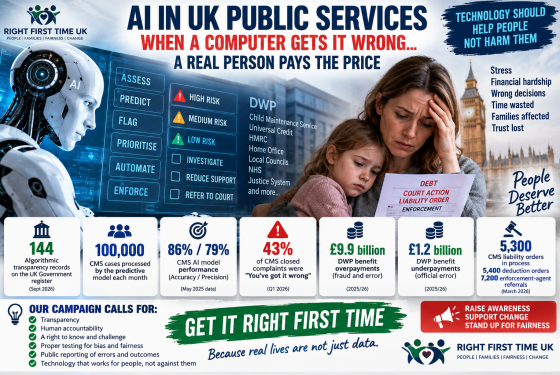
When a Computer Gets It Wrong, a Real Person Pays the Price
Right First Time UK supports technology that improves public services. We are not campaigning against artificial intelligence simply because it is AI.
Our concern is what happens when algorithms, machine-learning systems and automated decision-support tools are introduced into services that affect people's money, benefits, child maintenance, housing, immigration, policing, healthcare, justice and other important parts of their lives.
That is why RFTUK is calling for transparency, meaningful human oversight, accurate data, effective complaint routes and a clear right to challenge decisions influenced by algorithms.
AI Is Already Being Used Across UK Government
The UK Government maintains an Algorithmic Transparency Recording Standard register showing how government departments and public bodies use algorithms and artificial intelligence.
Published records cover areas including:
- social security;
- child maintenance;
- fraud prevention;
- policing;
- justice;
- health;
- local government;
- public administration.
The existence of an algorithm does not automatically mean a service is unsafe or unlawful. The public-interest question is whether the data is accurate, whether bias and error are measured, whether people know when technology materially affects their case, and whether a human can genuinely correct the outcome.
Child Maintenance Service — Machine Learning Is Live
The Department for Work and Pensions has officially disclosed a production machine-learning system called:
Child Maintenance Service Predictive Analytics Compliance
The system uses current and historical information from the CMS2012 system to predict the probability that a currently compliant Collect and Pay case may become non-compliant.
Approximately 100,000 cases are processed by the model around the start of each month.
DWP states that the system uses a trained XGBoost machine-learning model.
Predictions are presented as:
High
Medium
Low
probability of future non-compliance.
May 2025 validation data recorded:
86% accuracy
79% precision
DWP says the prediction supports a caseworker rather than making the final decision itself. RFTUK believes human review must be genuine and independent — not simply a person accepting a computer-generated risk score.
The Public Should Be Able to Ask These Questions
CMS Complaints — “You've Got It Wrong”
DWP's official complaints statistics for the quarter ending March 2026 recorded:
43% of CMS closed-complaint reasons in the quarter ending March 2026.
These figures do not prove that AI caused those complaints. They do show why algorithm-assisted systems operating inside services with substantial complaint volumes require strong scrutiny, audit and correction safeguards.
CMS Data Has Already Required Correction
DWP's own CMS statistics state that because of the complexity of the CMS2012 system, some maintenance had been miscategorised.
The published statistics describe this as approximately:
and explain that the calculation methodology was changed.
Labels such as:
“debt”
“arrears”
“non-compliant”
“payment failure”
should never be accepted blindly where the underlying information has not been checked. Automation cannot turn inaccurate source data into accurate evidence.
From a Digital Record to Enforcement
CMS can enforce unpaid maintenance through deductions and court processes. At the end of March 2026 official statistics recorded:
RFTUK is not claiming that the CMS predictive model automatically creates a liability order or calculates a person's maintenance debt. DWP describes the predictive model as a caseworker-support tool. Our concern is the wider chain: what safeguards prevent incorrect digital information from moving through a public service until it contributes to debt, recovery or enforcement?
How an Error Can Travel Through a System
This flow is an illustration of the risk RFTUK wants government to guard against. It is not a claim that every government algorithm follows this exact process.
Universal Credit — Machine Learning for Advance Requests
DWP has also published an Algorithmic Transparency Record for its:
Universal Credit Advances Model
The model is a supervised machine-learning classifier used to risk-assess requests for Universal Credit advances before payment as part of fraud-prevention work.
The important public-interest questions are:
- How many legitimate applicants are flagged?
- How are false positives measured?
- How quickly are cases reviewed?
- Can the claimant understand and challenge the decision?
Police, Justice, Health and Other Public Services
Algorithmic and AI-assisted systems are not limited to welfare and child maintenance. Government and public-sector transparency records show technology being used or developed across multiple high-impact services.
Facial recognition, matching and intelligence-support systems require strong accuracy, equality and human-review safeguards.
Data analysis, risk assessment, probation and case-management tools can operate in areas where errors may have serious consequences.
AI may assist diagnosis, prioritisation, administration and service planning, making clinical oversight and data quality essential.
Councils increasingly use data matching, automation and decision-support tools in services affecting residents.
AI Does Not Remove Government Responsibility
Government bodies often emphasise that a human makes the final decision.
That is important. But RFTUK believes the quality of human oversight must itself be measured.
Departments should know:
- how often staff disagree with algorithmic recommendations;
- how often system-selected cases are ultimately corrected;
- whether incorrect flags remain after review;
- whether people understand how to challenge the information.
What Right First Time UK Wants Government to Change
RFTUK is calling for a national:
FOR AI AND ALGORITHMIC PUBLIC SERVICES
- People should be told when an algorithm or AI system materially influences their case where disclosure is lawful and appropriate.
- People should be able to correct inaccurate source data before serious enforcement or financial action is taken.
- There should be a genuine right to human review.
- Public bodies should record and publish meaningful accuracy and error information.
- False-positive and false-negative rates should be published where disclosure can be done safely.
- Departments should publish how often human decision-makers disagree with or overturn algorithmic recommendations.
- Complaint, appeal and correction routes should be easy to understand.
- Equality, discrimination and bias testing should be independently scrutinised.
- Incorrect risk flags should be removed or corrected rather than silently remaining on a person's record.
- No public authority should rely on “the system says so” as an adequate explanation for a decision affecting a person's rights or money.
Our Campaign Is Not Anti-AI
Artificial intelligence can help government process information more efficiently, detect genuine fraud, identify patterns, reduce repetitive administration and improve services.
But efficiency must never replace fairness.
The more serious the consequence of a public-service decision, the stronger the human oversight, transparency, evidence and right of challenge should be.
Right First Time UK
AI AND THE BIG LIE
Artificial intelligence is being presented as one of the greatest technological developments of our time.
We hear that AI can “think.”
That it can “reason.”
That it can “understand.”
That it can “learn.”
Some even talk about AI as though we are creating a new form of intelligence capable of replacing human decision-making.
But we need to separate the technology from the hype.
THE BIG LIE
AI does not have a human brain.
It does not have a childhood, lived experience, conscience, emotions, morality or personal understanding of the consequences of its decisions.
When an AI produces an answer that sounds intelligent, there is a danger that people mistake convincing language for genuine human understanding.
Modern AI is extraordinarily sophisticated software.
It can analyse information, identify patterns, process language and generate responses at a speed and scale that would have seemed impossible only a few years ago.
That makes AI a powerful tool.
It does not make it a human mind.
The difference matters.
IT IS MORE THAN GOOGLE + ALEXA — BUT THE COMPARISON MAKES AN IMPORTANT POINT
For years we have used technology to search for information.
Google helped us find information.
Voice assistants such as Alexa allowed us to interact with computer systems through ordinary speech.
Generative AI takes this considerably further. Instead of simply retrieving a webpage or executing a predefined voice command, modern AI models can generate new combinations of language, analyse material, answer questions and perform complex tasks.
But underneath the impressive conversation is still a technological system.
There isn't a little person inside the computer thinking about your question.
An AI response can sound confident, compassionate or certain without experiencing confidence, compassion or certainty.
It can produce an excellent answer.
It can also produce a completely wrong answer that sounds excellent.
That is precisely why governments and public bodies must understand its limitations.
AI IS NOT “ONLY AS GOOD AS ONE PROGRAMMER”
There is another important distinction.
Modern AI isn't normally programmed by somebody manually writing every answer it will ever give.
Developers design the architecture, training methods, objectives, safeguards and systems around the model. Models are then trained using enormous amounts of data and computation.
This means developers do not simply write:
The behaviour emerges from training.
But human choices remain everywhere.
People decide what systems are built.
People select objectives and training processes.
People determine what data can be used.
People establish safeguards.
People decide where AI will be deployed.
And, most importantly, people decide whether an AI recommendation will affect another human being.
Therefore AI does not remove human responsibility.
THE REAL DANGER IS AUTOMATION BIAS
A computer-generated answer can look authoritative.
A risk score can look scientific.
An automated recommendation can look objective.
That does not mean it is correct.
If a government department feeds incomplete, inaccurate or biased information into an automated system, sophisticated technology does not magically make that information true.
AI may simply process the problem faster and at a much greater scale.
Imagine an incorrect record affecting one person.
A human administrator might make one incorrect decision.
An automated system potentially allows the same underlying problem to influence thousands of decisions.
Technology can therefore scale good administration.
But it can also scale bad administration.
GOVERNMENT MUST NEVER CONFUSE AUTOMATION WITH ACCOUNTABILITY
Right First Time UK is not calling for AI to be abandoned.
AI can be extremely useful.
It can help analyse large documents, identify patterns, translate complicated information into accessible language, assist staff, identify administrative errors and reduce repetitive workloads.
The issue is where the line is drawn.
When decisions concern someone's:
- benefits,
- disability support,
- child maintenance,
- housing,
- healthcare,
- education,
- immigration status,
- policing,
- employment,
- taxation,
- liberty,
- family,
- or legal rights,
there must be meaningful human responsibility.
A public authority should never be able to say:
A computer cannot be held democratically accountable.
The department using it can.
OUR CAMPAIGN CALL
Right First Time UK believes government departments and public authorities using artificial intelligence or automated decision-making should be required to provide transparency about how those systems affect the public.
People should know when AI or automation has materially contributed to a decision about them.
They should have a meaningful route to human review.
Important decisions should be explainable.
Information used by automated systems should be accurate and capable of being challenged.
There should be independent auditing for discrimination, systematic errors and harmful outcomes.
And there must always be an identifiable person or public authority ultimately accountable for the decision.
AI should assist human beings — not become an excuse for removing human responsibility.
VIDEO SCRIPT — AI AND THE BIG LIE
You've probably heard it.
“AI can think.”
“AI understands us.”
“AI is going to replace people.”
But there's something we need to talk about.
AI and the big lie.
AI doesn't have a human brain.
It doesn't wake up in the morning.
It doesn't have lived experience.
It doesn't have a conscience.
And it doesn't understand what losing your home, having your benefits stopped, fighting for your child's education or being wrongly accused of something actually feels like.
AI is technology.
Very impressive technology — but technology nonetheless.
Think about what happened before generative AI.
Google allowed computers to help us find information.
Alexa allowed us to speak to computer systems.
Modern AI has taken another enormous step. It can analyse information and generate incredibly convincing answers.
But sounding human and being human are completely different things.
And that's where this becomes important for government.
Because governments are increasingly looking towards AI and automation to make public services faster and cheaper.
Used properly, that could be enormously helpful.
But here's the problem.
If you give a powerful computer system bad information, the computer doesn't magically turn it into good information.
If the underlying records are wrong, the result can still be wrong.
If the system has weaknesses, those weaknesses can be repeated.
And if humans start believing the computer must be right simply because it is called artificial intelligence, we have created an even bigger problem.
Imagine getting a letter saying you owe thousands of pounds.
Imagine losing financial support.
Imagine being incorrectly classified as a risk.
And when you challenge it, you're effectively told:
That isn't accountability.
Technology should help public servants make better decisions.
It should never become a shield that protects organisations from responsibility for bad ones.
And here's perhaps the most important point:
AI cannot take responsibility for what happens to you.
The government department can.
The organisation can.
The people deploying the technology can.
So perhaps the biggest lie isn't that AI exists.
Of course it exists.
The lie is the idea that because we call something “artificial intelligence,” its output should automatically be treated as intelligent, objective or correct.
It shouldn't.
AI can be brilliant.
AI can be useful.
AI can help people.
But AI can also be wrong.
And when technology affects people's rights, families, money, homes or lives, a human being must remain accountable.
Use AI as a tool.
Don't mistake the tool for the decision-maker.
And never allow the words “artificial intelligence” to become an excuse for avoiding human responsibility.
RIGHT FIRST TIME UK
Have You Been Affected?
If you believe a public body has relied on:
- incorrect digital information;
- an automated decision;
- an unexplained risk flag;
- an incorrect system-generated debt;
- incorrect calculations;
- or data that does not match your evidence;
keep copies of letters, screenshots, calculations, complaint responses and appeal decisions.
When sharing experiences publicly, remove unnecessary personal information, account numbers, children's details and confidential court or medical material.
RFTUK may use anonymised patterns and documented evidence to identify wider public-service problems, while distinguishing individual allegations from findings established by official records, courts, tribunals or regulators.
Official Evidence & Sources
GOV.UK — Algorithmic Transparency Records GOV.UK — DWP Child Maintenance Service Predictive Analytics Compliance GOV.UK — Universal Credit Advances Model GOV.UK — DWP Complaints Statistics to March 2026 GOV.UK — Child Maintenance Service Statistics to March 2026Evidence Standard
Right First Time UK aims to distinguish between:
Information stated in:
official statistics,
algorithmic transparency records,
court or tribunal decisions,
regulator findings,
government publications,
or other reliable primary sources.
Individual accounts may identify a serious problem. They should not be presented as proven fact until independently supported by evidence.
This distinction allows Right First Time UK to challenge public bodies strongly while keeping the campaign accurate, fair and evidence-based.
GET IT RIGHT FIRST TIME
The computer can assist the decision. It must never remove responsibility for the decision.
When government technology gets something wrong, the public should not have to spend months proving that the computer was wrong.
AI • ALGORITHMS • PUBLIC SERVICES • HUMAN ACCOUNTABILITY
Transparency. Evidence. Fairness. Real Accountability.