

EHCP National Statistics — 2025 activity, published 2026
The Department for Education's accredited official statistics were published on 25 June 2026. They cover all English local authorities and the EHC plan system for children and young people aged 0 to 25.
Source: Department for Education — Education, health and care plans, Reporting year 2026.
How many refusals lead to mediation or Tribunal?
Refusal to assess
- 162,702 requests for EHC needs assessments were made in 2025.
- About 43,300 requests (26.6%) received a decision not to proceed to assessment.
- About 11,200 mediations related to decisions not to assess.
- About 5,100 SEND Tribunal cases related to decisions not to assess.
- About 1,600 of those mediations were then followed by Tribunal.
Not every refusal is appealed, so Tribunal numbers are not the total number of refusals.
Refusal to issue a plan after assessment
- 118,800 EHC needs assessments were carried out in 2025.
- A plan was to be issued in 111,200 cases (93.6%).
- A plan was not to be issued in about 7,200 cases (6.0%).
- About 2,400 mediations related to a decision not to issue.
- About 1,700 Tribunal cases related to a decision not to issue.
- For plan content disputes, there were about 2,100 mediations and 3,700 Tribunal cases.
SEND Tribunal appeals — academic year 2024/25
What were the appeals about?
| Appeal type | Share of registered SEN appeals | What it means |
|---|---|---|
| Refusal to secure an EHC needs assessment | 24% | The local authority decided not to assess. |
| Content of EHC plans | 61% | Disputes about plan content, including education sections and placement. |
| Other appeal types | Approx. 15% | Includes other appealable decisions; this remainder should not be treated as a single refusal-to-issue category. |
Official source: Ministry of Justice — Annual Special Educational Needs and Disability statistics.
Times local authorities should meet
Decision whether to assess
Legal limit: 6 weeks.
In 2025, 87.4% of assessment-request decisions were communicated within 6 weeks. Therefore 12.6% were outside that measure.
If the LA decides not to issue
Legal limit: 16 weeks from the original assessment request for notifying the decision not to issue, subject to statutory exceptions.
In 2025, only 37.4% of these no-plan decisions were notified within 16 weeks; 62.6% were outside that measure.
If a final EHC plan is issued
Whole process: normally no more than 20 weeks from the assessment request to final plan, subject to statutory exceptions.
In 2025, 46.1% of new plans were issued within the 20-week statutory timeframe (excluding cases where exceptions applied).
| Key figure at a glance | Figure |
|---|---|
| EHC needs assessment requests | 162,702 |
| Active EHC plans | 718,838 |
| SEND appeals registered, 2024/25 | 25,000 |
| Appeals about refusal to assess | 24% |
| Appeals about EHC plan content | 61% |
| Request decisions within 6 weeks | 87.4% |
| No-plan notifications within 16 weeks | 37.4% |
| New final plans within 20 weeks | 46.1% |
What these figures suggest
- Requests for EHC needs assessments remain very high and increased again in 2025.
- SEND Tribunal appeals reached a new record in 2024/25.
- Among cases actually decided by the Tribunal, the overwhelming majority were in favour of appellants.
- There continue to be significant timeliness problems in parts of the statutory process.
- The official figures support scrutiny of whether earlier, lawful and well-evidenced decisions could reduce avoidable disputes — but they do not by themselves prove a specific national cash saving.
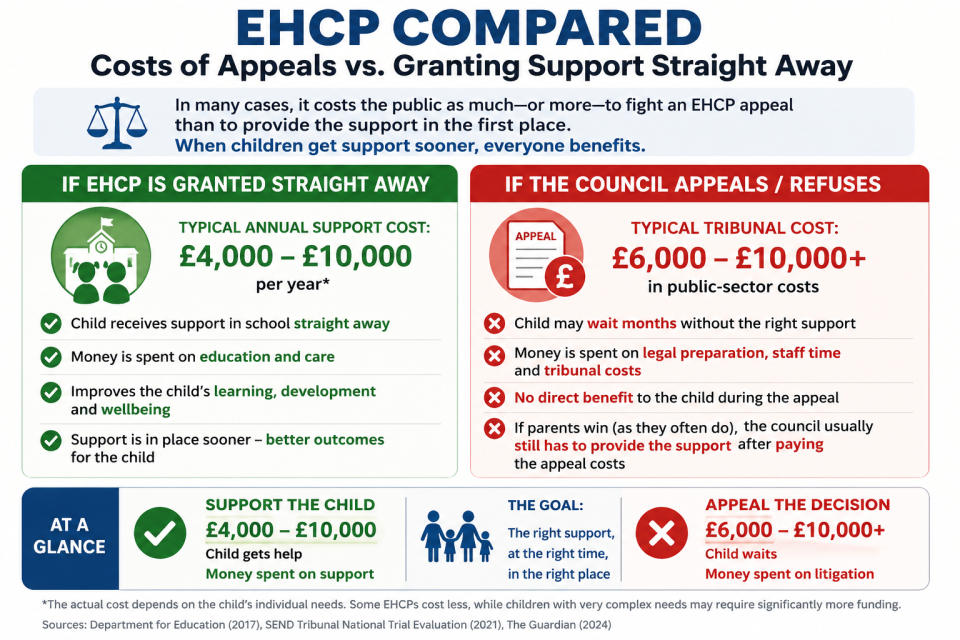
EHCP compared — costs of appeals vs providing support early
🟢 Grant support first time
Illustrative annual support ranges used in the campaign:
- Child receives support sooner.
- Money is directed toward education and provision.
- Earlier intervention can support educational progress and wellbeing.
- May avoid some dispute and litigation costs where a dispute would otherwise arise.
- Can reduce pressure on families and schools where the decision is correct and provision is delivered promptly.
🔴 Refuse → appeal
Illustrative appeal ranges used in the campaign:
- Months may pass while the dispute is being resolved.
- SEND officer time and case preparation.
- School and professional input may be required.
- Legal preparation and representation where used.
- Tribunal administration.
- Expert evidence where required.
- If the appeal succeeds, the local authority may still have to issue/amend the plan or secure the resulting provision.
What the DfE-commissioned cost research actually estimated
The 2017 independent review of SEND disagreement-resolution arrangements estimated local-authority costs from sample survey data. For a full appeal including a hearing, with no mediation, estimated costs were:
| Historical model | Low complexity | Medium complexity | High complexity |
|---|---|---|---|
| No mediation + full appeal including hearing | £4,166 | £6,056 | £9,632 |
| Mediation + full appeal including hearing | £4,752 | £6,908 | £10,988 |
The research itself cautioned that the figures were based on samples and could not be assumed to represent every local authority. They are useful evidence that a full appeal carries material administrative and professional cost, but they should not be presented as today's universal cost per appeal.
Official/commissioned sources: DfE/MoJ SEND disagreement-resolution review and DfE Parliamentary answer confirming £6,056 medium-complexity estimate.
At a glance
Grant support early: campaign illustration £3k–£30k+ per year, with money directed to provision.
Tribunal route: campaign illustration £4k–£20k+ for dispute activity, alongside any provision eventually required.
These are not like-for-like official unit costs. One is an illustrative annual support range; the other is an illustrative dispute-cost range. They should not be added or compared as though every case has the same needs, outcome or cost.
Original 25,000-appeal cost model
The original campaign model asks what total expenditure would look like if all 25,000 registered appeals were assigned the same assumed average cost. The arithmetic is shown below. This is a scenario model, not a measure of actual national Tribunal expenditure.
| Assumed average cost per appeal | Total for 25,000 appeals | 98% of total | Remaining 2% |
|---|---|---|---|
| £4,000 | £100,000,000 | £98,000,000 | £2,000,000 |
| £6,000 | £150,000,000 | £147,000,000 | £3,000,000 |
| £10,000 | £250,000,000 | £245,000,000 | £5,000,000 |
| £20,000 | £500,000,000 | £490,000,000 | £10,000,000 |
If 25,000 appeals each cost an assumed average of £6,000, the model produces £150 million. That does not mean government statistics show £150 million was actually spent: the number of appeals, the mix of outcomes, the resources used and the cost per case all vary.
If every request had been approved for an EHC needs assessment
The cost would be the cost of carrying out assessments — not the cost of issuing an EHCP to every child.
- Requests for assessment: 162,702.
- Assessments carried out during 2025: around 118,800.
- Original arithmetic difference: 43,902.
Because there is no single official national cost for an EHC needs assessment, the following estimates are scenario calculations only. Actual costs vary according to professional involvement, for example educational psychology, speech and language therapy, occupational therapy, medical advice and administration.
Estimated cost if all 162,702 requests were assessed
| Assumed cost per assessment | Illustrative total for 162,702 assessments |
|---|---|
| £1,500 | £244.1 million |
| £2,000 | £325.4 million |
| £2,500 | £406.8 million |
| £3,000 | £488.1 million |
Original “extra 43,902 assessments” scenario
| Assumed cost per extra assessment | Illustrative additional cost |
|---|---|
| £1,500 | £65.9 million |
| £2,000 | £87.8 million |
| £2,500 | £109.8 million |
| £3,000 | £131.7 million |
Original 98% “support plus Tribunal” model
Using the campaign's hypothetical assumption that 98% of 25,000 = 24,500 cases eventually obtained the decision or provision sought, with 500 representing 2%, the original model is:
| Cost level | Tribunal cost for all 25,000 | Support for 24,500 cases | Combined after dispute |
|---|---|---|---|
| Low: £4,000 each | £100m | £98m | £198m |
| Lower-mid: £6,000 each | £150m | £147m | £297m |
| Mid-high: £10,000 each | £250m | £245m | £495m |
| High: £20,000 each | £500m | £490m | £990m |
If those hypothetical 24,500 cases had been agreed straight away
| Assumed cost per child | Estimated direct support | Modelled dispute expenditure potentially avoided |
|---|---|---|
| £4,000 | £98m | Up to £100m |
| £6,000 | £147m | Up to £150m |
| £10,000 | £245m | Up to £250m |
| £20,000 | £490m | Up to £500m |
Low estimate
Provide support straight away: £98m
Tribunal + eventual support: £198m
Modelled difference: £100m
Mid estimate
Provide support straight away: £147m
Tribunal + eventual support: £297m
Modelled difference: £150m
Higher estimate
Provide support straight away: £245m
Tribunal + eventual support: £495m
Modelled difference: £250m
Highest estimate
Provide support straight away: £490m
Tribunal + eventual support: £990m
Modelled difference: £500m
Would more timely assessments and earlier decisions reduce costly disputes and improve outcomes?
1. Early identification and support matter
The SEND Code of Practice is built around identifying needs and putting appropriate support in place, with education, health and care bodies working together. The National Audit Office has also called for a stronger whole-system approach, including identifying and addressing needs earlier.
2. Disputes consume public resources
A Tribunal case may involve SEND officers, local-authority preparation, school evidence, professional evidence, legal input where used, hearing attendance and Tribunal administration. The DfE-commissioned 2017 work put a medium-complexity full-appeal LA cost at about £6,056 without mediation.
3. Tribunal decisions overwhelmingly favour appellants
For 2024/25, the MoJ says 99% of cases decided by the Tribunal were in favour of the appellant. This makes the quality and timing of first-instance decision making a legitimate subject for scrutiny.
4. Delay can leave needs unresolved
The impact differs by child, but delay can mean uncertainty over provision and placement, increased pressure on families and schools, and longer periods before a disputed decision is resolved.
The National Audit Office concluded in 2024 that England's SEN system was not achieving value for money and was financially unsustainable, despite increased high-needs funding. It urged government to consider how investment could be better spent, including more inclusive education and earlier identification and support.
Official source: National Audit Office — Support for children and young people with special educational needs.
What the law requires
Children and Families Act 2014 — section 36
This is the core statutory provision for EHC needs assessments. The local authority must apply the legal test in section 36 when deciding whether to secure an assessment and must consult the parent or young person.
Children and Families Act 2014 — section 37
After an EHC needs assessment, if it is necessary for special educational provision to be made in accordance with an EHC plan, the local authority must prepare and maintain a plan.
Children and Families Act 2014 — section 42
Where an EHC plan is maintained, the local authority must secure the special educational provision specified in the plan, subject to the statutory framework.
SEND Regulations 2014
The regulations contain detailed procedural and timing rules for EHC needs assessments, plans, reviews and related notices.
Read the Special Educational Needs and Disability Regulations 2014
If a local authority refuses, delays or fails to deliver provision
Appeal to the SEND Tribunal
GOV.UK says an appeal can be made against decisions including refusal to assess or reassess, refusal to create an EHC plan after assessment, specified disagreements about an existing plan, or a decision that a plan is no longer needed.
In most cases you must contact a mediation adviser before appealing, although there are exceptions such as an appeal only about the named school or institution.
Official guide: when you can appeal
Official guide: mediation before appeal
Complain about delay or failure to secure provision
The Local Government and Social Care Ombudsman generally cannot investigate the merits of a decision carrying a SEND Tribunal appeal right. But it can investigate some matters such as delay in the EHC assessment/review process and failure by a council to secure provision specified in an EHC plan.
SEND reforms proposed in 2026 — distinguish proposals from current law
The government published its SEND reform consultation, Putting children and young people first, on 23 February 2026. The consultation closed on 18 May 2026. It proposes significant future changes, including a greater emphasis on early support, national standards, multidisciplinary working, changes to the future role of EHC plans and increased use of mediation.
The consultation material says there will be no changes to support received through existing EHC plans before at least September 2030, while planned changes would be phased in over later years.
Official DfE SEND reform consultation • Full HTML consultation document
EHCP whistleblower: ITV News report
On 3 July 2026, ITV News reported allegations from an anonymous local-authority SEND caseworker. The whistleblower alleged that senior managers encouraged staff to make it harder for families to access SEND support, that managers joked about denying support, and that staff were discouraged from creating written records or engaging fully with families.
These are allegations reported by ITV News from one protected source. They should not be presented as proven conduct by every council or as an official national finding.
ITV also reported the Education Secretary's response that any suggestion of this kind of behaviour was “completely unacceptable” and that families should not have to battle so hard for support.