
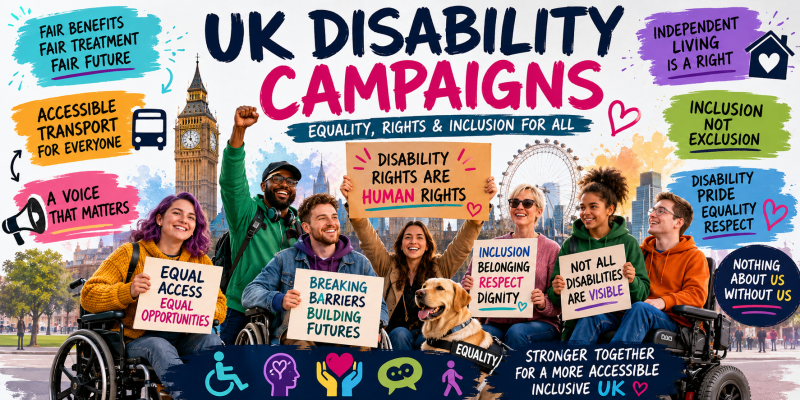
Disability Rights Campaigning
Disability campaigning covers far more than benefits.
Campaigns across the UK are pushing for:
- Fair disability benefits
- Accessible employment
- Independent living
- Accessible housing
- Accessible transport
- Better social care
- Accessible healthcare
- Inclusive education and SEND support
- Accessible information
- Accessible public spaces
- Better legal protection
- Action on disability hate crime
- Political participation
- Recognition of hidden disabilities
- Removal of barriers affecting disabled children
This page brings together campaigns and petitions. It is not a benefits guide or disability-advice page.
Campaigns are labelled where they are active, continuing, campaign wins or legacy campaigns.
Scope – National Disability Campaigns
Scope campaigns on issues identified by disabled people and their families, including benefits, employment, additional disability costs, transport, attitudes and accessibility.
Scope – Work Without Barriers
Disabled people continue to face barriers entering and staying in work.
Scope's current campaign is calling for:
- Disability pay-gap reporting
- Better workplace adjustments
- More flexible working
- Stronger disability equality at work
- Progress on the Equality (Race and Disability) Bill
Scope and partner organisations sent an open letter to Government in June 2026 calling for the draft Bill to be brought forward.
Scope – Futureproofing Benefits
Scope's major 2026 disability-benefits campaign is focused on the future of PIP, Universal Credit health support and disability assessments.
Its priorities include:
- Keeping PIP separate from assessment of ability to work
- Keeping disability extra-cost support separate from income replacement
- Reforming the system rather than cutting support
- Making assessments more dignified
- Reducing unnecessary reassessments
- Co-designing reform with disabled people
Scope – Benefits Without the Fight
Benefits Without the Fight campaigns for a fairer disability-benefits assessment system.
Scope has highlighted:
- Inaccurate assessments
- Unnecessary appeals
- Stress and financial hardship
- Delays
- Assessors lacking appropriate knowledge
Campaign Goals
- Improve assessment quality
- Reduce unnecessary reassessments
- Improve assessor knowledge and training
- Allow people to request an assessor with appropriate knowledge
- Create a more humane process
Scope – Disability Price Tag
The Disability Price Tag highlights the extra costs disabled households face simply because of disability.
Costs can include:
- Higher energy bills
- Specialist equipment
- Accessible transport
- Care and support
- Home adaptations
- Higher insurance and service costs
Scope's 2025 research estimated that disabled households needed an additional average of around:
£1,095 every month
to achieve a comparable standard of living to non-disabled households.
Scope – Travel Fair
Travel Fair campaigns for disabled people to have equal and independent access to public transport.
Key Issues
- Broken lifts
- Inaccessible stations
- Poor assistance
- Staff training
- Difficult booking processes
- Weak accountability
Campaign Goals
- Step-free access
- Reliable assistance
- Consistent accessibility standards
- Improved passenger rights
- Clear accountability
Scope – Let's Play Fair
Let's Play Fair campaigns for accessible playgrounds where disabled and non-disabled children can play together.
Goals
- Inclusive playground design
- Accessible play equipment
- Better local-authority planning
- Equal opportunities for play
- Parents to be involved in playground design
Scope – Invisible Disabilities
Scope supported ITV's campaign highlighting that many disabilities and health conditions are not immediately visible.
Examples can include:
- Autism
- Chronic pain
- Mental-health conditions
- Epilepsy
- ME / chronic fatigue conditions
- Hearing loss
Campaign Goals
- Increase understanding
- Reduce judgment
- Challenge assumptions
- Improve accessibility
- Encourage disability allyship
Scope – Stuck: Reform Sick Pay
Scope and Mind campaigned for Statutory Sick Pay to become more inclusive and financially secure.
Campaign asks included:
- Removing waiting days
- Wider eligibility
- Better financial protection
- Flexible sick pay
- Support lasting longer where needed
- Reducing disability-related workplace inequality
Scope – End the Awkward
End the Awkward was one of Scope's major public-attitudes campaigns.
It challenged:
- Social awkwardness around disability
- Stereotypes
- Fear of saying the wrong thing
- Negative assumptions
Its message continues to be relevant to disability-awareness work, although Scope now describes it as a past campaign.
Scope – We Won't Be Forgotten
This campaign highlighted the effect of the pandemic and economic pressures on disabled people.
Its themes included:
- Poverty
- Energy bills
- Food insecurity
- Social-care pressures
- Disability-related expenses
- Ensuring disabled people were not overlooked by government
Disability Rights UK & Disabled People's Organisations
Campaign for a New UK Accessibility Act
Disability Rights UK and Disabled People's Organisations are developing a campaign for a dedicated:
UK Accessibility Act.
The proposal is for legislation to sit alongside existing equality law and create stronger accessibility duties covering areas such as:
- Transport
- Housing
- Built environment
- Technology
- Communication
- Employment
- Goods and services
Disability Rights UK's 2026 survey reported overwhelming support among respondents for stronger accessibility legislation.
Disability Benefits Reform & PIP Review
Disability Rights UK and other DPOs are actively participating in and scrutinising the 2026 Timms Review of Personal Independence Payment.
Campaign priorities include:
- Disabled people helping design reform
- Protecting disability support
- Fairer PIP assessments
- A benefits system based on dignity
- Recognition of disability-related costs
- Preventing reform from becoming a route to benefit cuts
Protect Access to Work
Disability Rights UK and allied Disabled People's Organisations are campaigning to protect and properly fund:
Access to Work.
The scheme can support disabled people with equipment, support workers, travel and workplace adjustments.
Campaigners are asking disabled people and allies to contact MPs about delays, funding pressures and proposed changes.
Independent Living
Independent Living is a central part of the UK disability-rights movement.
Campaigners argue that disabled people should have the support and resources required to choose:
- Where they live
- Who they live with
- Who supports them
- How support is provided
- How they participate in their community
Campaign priorities include:
- Accessible housing
- Personal assistance
- Adequate income
- Accessible transport
- Inclusive education
- Equal employment
Independent Inquiry Into Benefit-Related Deaths
Disability Rights UK continues to call for an:
Independent inquiry into benefit-related deaths.
Its campaign position includes calls for:
- DWP investigations to be made public
- Greater safeguarding accountability
- A legal duty of care
- Reasonable adjustments to be consistently provided
- Lessons from serious cases to be acted upon
Disabled People's Manifesto & Rights Priorities
Disabled People's Organisations have repeatedly developed manifestos setting out priorities created by disabled people themselves.
Common themes include:
- Independent living
- Social care
- Employment
- Housing
- Transport
- Human rights
- Education
- Adequate income
- Accessible public services
Current 2026 national and devolved manifestos are included later on this page.
Accessible Housing
Disability organisations continue to campaign for:
- More wheelchair-accessible homes
- Adaptable housing standards
- Affordable accessible accommodation
- Clear information about accessibility
- Disabled people being involved in housing policy
Several live Parliament petitions on accessible housing are included below.
Accessible Elections
Disabled People's Organisations campaign for disabled people to be able to participate equally in elections and political life.
Common campaign demands include:
- Accessible polling stations
- Accessible election material
- Voting independently and secretly
- Support for disabled candidates
- Accessible political meetings
Disability Hate Crime
Campaigners continue to push for better prevention and response to disability-related harassment and hate crime.
Campaign priorities include:
- Better reporting systems
- Improved police training
- Consistent recording
- Support for victims
- Stronger national strategy
A live UK Parliament petition currently calls for a National Disability Hate Strategy.
Learning Disability Campaigns
Mencap – Homes Not Hospitals
Mencap campaigns against inappropriate long-term detention of people with learning disabilities and autistic people in mental-health inpatient units.
The campaign calls for:
- Community-based support
- Suitable housing
- Earlier intervention
- Better crisis support
- Families to be listened to
- People to live in homes rather than hospitals wherever possible
Mencap's June 2026 data reported more than 2,000 people with a learning disability and/or autism in inpatient mental-health hospitals in England.
Mencap – I'm In
The I'm In campaign raises awareness of the GP learning disability register.
Mencap wants more people with a learning disability to be identified by GP practices so they can access appropriate healthcare support, including annual health checks where eligible.
Campaign Goals
- Increase awareness of the register
- Improve annual health-check uptake
- Reduce health inequalities
- Improve reasonable adjustments
- Help people get earlier medical support
Mencap – Disability Benefits
Mencap campaigns against benefit reforms that it believes could reduce financial support for people with a learning disability.
Its campaigning includes:
- PIP
- Universal Credit
- Fair assessments
- Financial security
- Recognition of additional disability costs
Autism Campaigns
National Autistic Society – Education
The National Autistic Society campaigns for an education system that better meets the needs of autistic children and young people.
Issues include:
- SEND support
- School inclusion
- Staff knowledge
- Attendance barriers
- Appropriate specialist support
Empowering Autistic Voices
The National Autistic Society campaigns to ensure autistic people can influence political decisions and policies affecting their lives.
The principle is:
Autistic people should help shape decisions about autistic people.
Tackling Autism Misinformation
The National Autistic Society is campaigning against misinformation and harmful myths about autism.
The campaign seeks to:
- Increase public understanding
- Challenge inaccurate claims
- Promote evidence-based information
- Reduce stigma
Autism – Mental Health
Campaigning focuses on making mental-health services work better for autistic people.
Priorities include:
- Autism-informed mental-health support
- Early intervention
- Reasonable adjustments
- Preventing people reaching crisis
Autism – Employment & Benefits
The National Autistic Society campaigns for autistic people who can and want to work to receive appropriate employment support, while ensuring people unable to work receive appropriate financial support.
Disabled Children & SEND Campaigns
Disabled Children's Partnership – SEND Reform
The Disabled Children's Partnership brings together organisations campaigning for disabled children and their families.
During the 2026 SEND reforms it has called for:
- Existing legal rights to be protected
- Disabled children to remain at the centre of reform
- Clear enforceable support standards
- Better health and care involvement
- A stronger specialist workforce
- Better support in mainstream education
- Families and young people to be involved in reform
Fight for Ordinary
The Disabled Children's Partnership's wider campaign vision is for disabled children to be able to enjoy the ordinary opportunities other children take for granted.
Campaign themes include:
- Education
- Health
- Social care
- Family support
- Play
- Community inclusion
ALLFIE – SEND Reform
The Alliance for Inclusive Education campaigns for disabled children and young people to have a right to inclusive mainstream education.
Its 2026 SEND campaign calls for:
- Inclusive education
- Protection of disabled children's rights
- Less segregation
- Disabled people to help design reform
- Investment in inclusive mainstream provision
Contact – Fix Disabled Children's Social Care
Contact argues that disabled children's social care needs major reform.
Campaign areas include:
- Clearer law
- Better funding
- A larger skilled workforce
- Consistent assessments
- Family support
- Respite and short breaks
Contact – School Transport Campaign
Contact campaigns against gaps in transport provision affecting disabled young people.
It argues that disabled young people should not be denied education because suitable transport is unavailable or unaffordable.
Contact – Unlock Child Trust Funds
Contact supports a parent-led campaign concerning disabled young people who cannot easily access money in Child Trust Funds or Junior ISAs after turning 18 where they lack capacity to manage the account.
Contact estimates tens of thousands of disabled young people may be affected.
Contact – Counting the Costs
This campaign highlights the financial pressure faced by families with disabled children.
Campaign asks include:
- Better disability-benefit support
- Affordable energy
- Inclusive childcare and breakfast clubs
- Benefit checks
- Action on disabled-child poverty
Sight Loss & Accessible Information Campaigns
RNIB – Inclusive Journeys
RNIB campaigns for streets and public transport to be safer and more accessible for blind and partially sighted people.
Its work addresses:
- Rail accessibility
- Bus travel
- Street design
- Pavement barriers
- Passenger information
RNIB – Accessible Voting
RNIB campaigns for blind and partially sighted people to be able to vote independently and secretly.
Campaign issues include:
- Accessible ballot papers
- Voting equipment
- Accessible election information
- Polling-station support
RNIB – Alt Text Campaign
RNIB campaigns for better use of alternative text so digital images can be understood by people using screen readers.
RNIB – Fairer Welfare & Benefits
RNIB campaigns for disability assessments and benefit rules that understand sight loss and provide timely and accurate decisions.
RNIB is also engaging with current PIP and Universal Credit reform.
Guide Dogs – Streets Ahead
Streets Ahead campaigns to make public spaces safer for people with sight loss.
Campaign issues include:
- Pavement parking
- Street clutter
- Shared-surface streets
- Accessible crossings
- Safe pedestrian routes
Guide Dogs – Accessible Transport
Guide Dogs campaigns for people with sight loss to travel independently and confidently.
Campaign work includes:
- Accessible buses
- Audio-visual announcements
- Taxi and private-hire access
- Safe electric vehicles
- Reliable assistance
Deafness & Hearing Loss Campaigns
RNID – Accessible TV, Subtitles & Signing
RNID has been campaigning during 2026 around Ofcom rules for subtitles and signing on major on-demand television services.
The campaign seeks better access to:
- Subtitles
- Signing
- Accessible on-demand programmes
- Clearer accessibility standards
RNID – Hearing Healthcare
RNID is campaigning to improve access to:
- Audiology
- Hearing care
- Ear-wax removal
- Early diagnosis
- Accessible healthcare
In July 2026 MPs attended an RNID parliamentary event examining barriers to hearing care.
Accessible Transport Campaigns
Transport for All – Unlock Transport Access
Transport for All is campaigning to reform disabled concessionary travel.
Its demands include:
- Disabled bus passes usable at any time
- A national disabled bus-pass card
- Consistent eligibility rules
- An accessible application system
- Support for carers or personal assistants travelling with disabled people
- Ending local postcode differences
Disabled Bus Pass – All-Day Travel
Transport for All welcomed a 2026 commitment that from April 2027 disabled bus passes in England should be usable at any time of day.
The organisation continues campaigning on the wider remaining accessibility demands.
Changing Places Campaign
Changing Places Toilets
For more than 20 years, disabled people, families and campaigners have campaigned for properly equipped Changing Places toilets.
Changing Places facilities include equipment such as:
- Adult-sized changing benches
- Hoists
- Extra space
- Appropriate sanitary facilities
- Room for carers and personal assistants
The campaign aims to prevent people being:
- Changed on toilet floors
- Forced to leave venues early
- Excluded from days out
- Prevented from participating in community life
Wales – Disabled People's Campaigns
Disability Wales – From Barely Surviving to Truly Thriving
Disability Wales' Disabled People's Manifesto 2026–2031 was co-produced with Disabled People's Organisations and more than 250 disabled people.
Its key calls for change include:
- Incorporating the UN disability convention into Welsh law
- A strong Disabled People's Rights Plan
- Disabled people in leadership and decision-making
- The right to independent living
- Greater financial security and welfare reform
Disability Wales – Access to Politics Charter
The Access to Politics Charter campaigns to increase meaningful participation and representation of disabled people in Welsh politics.
It calls for political organisations to:
- Remove accessibility barriers
- Make meetings accessible
- Support disabled candidates
- Provide accessible information
- Increase disabled representation
Scotland – Disabled People's Campaigns
Inclusion Scotland – Manifesto for Inclusion
The 2026 Manifesto for Inclusion sets out seven major priorities identified by disabled people and DPOs in Scotland.
They are the right to:
- Independent living
- An adequate standard of living
- Be involved in decisions
- Education and employment
- Climate justice
- Accessible communities
- Human-rights protection
Glasgow Disability Alliance – Manifesto for a Fairer Scotland
Glasgow Disability Alliance's 2026 manifesto calls for systemic changes intended to give disabled people the same freedom and opportunities as non-disabled people.
Campaign themes include:
- Independent living
- Social-care reform
- Accessible communities
- Income security
- Human rights
- Participation in decisions
Our Lives. Our Rights. Our Futures.
Scottish Centres for Independent Living have campaigned together for disabled people's right to independent living and equality.
The campaign focuses on:
- Choice and control
- Social care
- Personal assistance
- Accessible housing
- Equal participation
Northern Ireland – Disability Rights Campaigning
Disability Action Northern Ireland
Disability Action campaigns for the rights of d/Deaf and disabled people across Northern Ireland.
Its work includes:
- Independent living
- Employment
- Accessible transport
- Housing
- Equality
- Political participation
- Accessible public services
- Disability strategy
Reopen Northern Ireland's Independent Living Fund
Disabled People's Organisations and campaigners have called for Northern Ireland's Independent Living Fund to reopen.
Campaigners argue that people in Northern Ireland should have comparable access to independent-living support and control over assistance.
Protect Community Disability Services
Disability Action and voluntary-sector organisations raised concerns in 2026 about major reductions in community funding in Northern Ireland.
Campaigners warned that reductions could affect services supporting:
- Disabled people
- Employment
- Independent living
- Community participation
- People facing multiple barriers
Justice for Jodey Whiting
From One Family's Campaign to a Wider Call for Change
Jodey Whiting was a disabled woman whose Employment and Support Allowance was wrongly stopped in 2017.
Her mother, Joy Dove, spent years campaigning for a second inquest to properly examine the role of Department for Work and Pensions failings.
The Court of Appeal authorised a fresh inquest in 2023.
That second inquest was finally held in June 2025.
What the Second Inquest Found
The Senior Coroner concluded that the DWP's decision to stop Jodey's benefits was the trigger for the deterioration that led to her death.
The evidence also identified multiple missed opportunities to recognise her vulnerabilities and correct the decision.
Joy Dove's campaigning has gone beyond securing another inquest. It has become part of wider calls for:
- Better safeguarding of vulnerable benefit claimants
- DWP accountability
- Proper consideration of mental-health vulnerabilities
- Reasonable adjustments
- Independent investigation of benefit-related deaths
- Lessons from serious cases to be made public
Philippa Day – Benefit Safeguarding & System Reform
Philippa Day's case has also become an important part of campaigning around disability-benefit safeguarding.
In 2021 the coroner found that problems in the benefits system were the:
“predominant factor”
in the events leading to her death.
Problems examined included:
- Assessment arrangements
- Inaccurate records
- Automated correspondence
- Failure to appropriately respond to vulnerability
- PIP administration
A later safeguarding review examined the impact of actions by the DWP and its assessment contractor.
Campaign Demand
Disability Rights UK responded by calling for an independent inquiry into benefit-related deaths and stronger safeguarding responsibilities within the DWP.
Live Disability Petition Directory
The petitions below are created by members of the public and are hosted by the UK Parliament petition system.
The petition descriptions are requests made by their creators. Listing a petition does not mean Right First Time UK has verified or endorsed every claim made within it.
Signature counts are deliberately not displayed because they change continuously.
Live UK Parliament Disability Petitions
Accessible Changing Benches for Disabled Children
Calls for large public venues to provide accessible changing benches for disabled children who have outgrown standard baby-changing facilities.
Closes: 9 October 2026
Penalties for Repeated Breaches of SEND Law
Calls for enforceable penalties where public bodies repeatedly breach their statutory SEND duties.
Closes: 8 November 2026
Reinstate Post-16 Transport for Disabled Young Adults
Calls for dedicated transport provision for disabled young people attending post-16 education.
Closes: 25 September 2026
Parental Responsibility for Severely Disabled Adults
Calls for a safeguarded mechanism for parental responsibility to continue after 18 where a young person severely and permanently lacks capacity, rather than families always needing Court of Protection deputyship.
Closes: 23 September 2026
Protect Higher Motability Mileage Options
Calls for higher-mileage options to remain available to disabled people who need to travel more than the standard allowance.
Closes: 27 October 2026
Allow Regular Carers to Continue Visits in Hospital
Calls for guidance so disabled hospital patients can continue receiving appropriate support from regular care workers while admitted.
Closes: 8 October 2026
Require Venues to Publish Accessibility Information
Calls for venues, shops and businesses to provide clear, up-to-date accessibility information online.
Closes: 3 February 2027
Accessible Social Housing Floor Plans
Calls for social-housing providers to publish floor plans and key accessibility measurements for homes advertised as accessible.
Closes: 12 September 2026
Properly Equipped Accessible Hotel Rooms
Calls for large hotel chains to provide a minimum number of rooms with appropriate disability-access equipment and clear accessibility information.
Closes: 29 November 2026
Legally Binding NHS Wheelchair Waiting Standards
Calls for NHS wheelchair assessment, repair and replacement standards to become legally enforceable.
Closes: 26 September 2026
Protect Disabled Students' Allowance Technology Funding
Calls for specialist assistive-technology support under Disabled Students' Allowance to be retained.
Closes: 8 December 2026
PIP & Type 1 Diabetes
Calls for PIP standards and assessment practice to more clearly recognise the impact of managing Type 1 diabetes.
Closes: 2 December 2026
End Routine PIP Reassessments for Lifelong Conditions
Calls for people with lifelong and progressive conditions to be protected from routine repeat PIP assessments.
Closes: 4 February 2027
Mandatory Hidden Disability Training
Calls for hidden-disability training to become mandatory across public services.
Closes: 26 December 2026
Changing Places in All Public Buildings
Calls for Changing Places standard facilities to become mandatory in public buildings.
Closes: 1 January 2027
National Disability Hate Strategy
Calls for a dedicated UK-wide strategy to tackle disability hate, harassment and abuse.
Closes: 17 February 2027
Accessible Gaming
Calls for video-game developers to provide adaptable accessibility options for disabled users.
Closes: 27 September 2026
Disabled Toilets on Commercial Flights
Calls for accessible toilet facilities for disabled passengers on commercial aircraft.
Closes: 8 December 2026
Wheelchair-Accessible Motorway Emergency Areas
Calls for emergency safety areas and motorway barriers to be made accessible to wheelchair users.
Closes: 3 January 2027
Specialist Disability Buggies on Public Transport
Calls for national guidance on how specialist disability buggies should be accommodated on public transport.
Closes: 26 September 2026
Include SEND Children in Universal Breakfast Clubs
Calls for government-funded breakfast-club schemes to be accessible to all SEND children, including those requiring additional staffing or support.
Closes: 20 November 2026
There Are Many More Live Disability Petitions
The UK Parliament petition system currently returns more than 100 open petitions containing the search term “disability”.
New petitions are added and old petitions close regularly.
Search All Open Disability PetitionsScottish Parliament Disability Petitions
Stage Not Age – Complex Medical Needs
A Scottish Parliament petition currently under consideration calls for a:
“stage not age”
approach to health, social care and benefits for people with exceptionally complex medical needs.
The petition argues that support should be based more on individual circumstances and developmental needs rather than abrupt age thresholds.
The petition has been under consideration since:
29 July 2026.
Different Campaigns – Shared Barriers
Independent Living
Disabled people should have genuine choice and control over their lives, care, support and living arrangements.
Fair Benefits
Benefits should recognise real disability-related costs and should not require people to repeatedly fight to prove established needs.
Accessible Transport
People should be able to travel for work, healthcare, education and everyday life without inaccessible infrastructure stopping them.
Accessible Information
Digital services, websites, healthcare information, public bodies and businesses should provide information disabled people can use.
Accessible Housing
Disabled people need homes designed or adapted around real accessibility requirements.
Inclusive Education
Disabled children should receive the education and support they need without families having to repeatedly fight for it.
Accessible Healthcare
Disability should not mean worse healthcare, poorer communication or preventable inequalities.
Nothing About Us Without Us
Policies affecting disabled people should be designed with disabled people rather than imposed on them without meaningful involvement.
Disability Rights Are About Equal Participation
Campaigns across the UK cover many different issues.
But the same barriers appear repeatedly:
Inaccessible systems. Unaffordable extra costs. Poorly designed services. Lack of support. Long waits. And disabled people not being listened to.
Campaigning is about more than asking for help.
It is about removing the barriers that stop disabled people from participating equally in society.
Accessibility • Equality • Dignity • Independence • Choice • Rights
Right First Time UK
This page is a campaign-awareness directory and not individual legal, benefits, medical or social-care advice.
Campaign organisations and petition creators have their own policy positions. Inclusion on this page does not mean Right First Time UK endorses every claim, proposal or policy they publish.
Some Scope campaigns listed on this page are historic or legacy campaigns. They have been clearly labelled rather than being presented as new 2026 campaigns.
Disability law, benefits and social-care systems differ across England, Wales, Scotland and Northern Ireland.
Public petitions are created by members of the public. Petition wording represents the petition creator's request rather than an independent finding of fact.
Petition closing dates and status can change. Always open the Parliament page before promoting or signing a petition.
Cases concerning deaths linked to benefit administration have been described carefully using findings from inquests and published reports. Those cases are included because they are central to current campaigning for safeguarding and accountability.
Campaign directory checked: 29 August 2026.