

Build vocabulary
Move beyond broad words such as “good”, “bad”, “angry” or “sad” and explore more precise language.
A practical emotion-vocabulary resource for teachers, parents, carers and young people — with ideas for using the Emotion Wheel at school and at home.
An emotion wheel can help someone move from a broad feeling such as happy, sad, angry or fearful to a more precise word that better describes what they are experiencing.
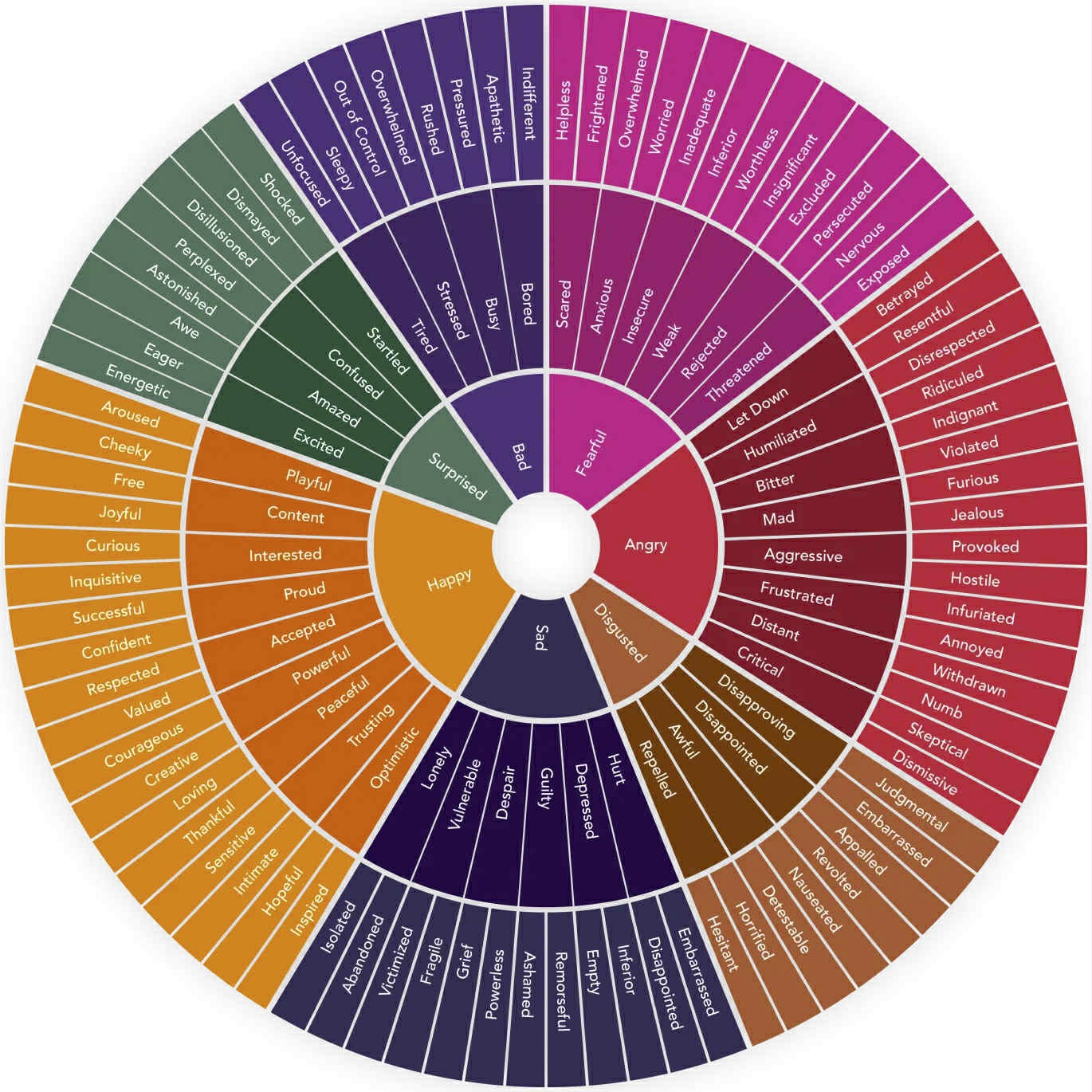
Some children, young people and adults know that something feels wrong but find it difficult to identify or describe the feeling. A visual tool can offer words without demanding an immediate verbal explanation.
Move beyond broad words such as “good”, “bad”, “angry” or “sad” and explore more precise language.
A learner can point to a word, colour or part of the wheel instead of having to explain everything verbally.
Over time, people may notice situations that repeatedly lead to feelings such as anxiety, frustration, loneliness or excitement.
The wheel can give adults and children a shared starting point for talking about what happened and what support may help.
After an event, use the wheel when the person is calm enough to think about how they felt before, during and afterwards.
For some learners, choosing from visible words can be easier than being asked an open question such as “How do you feel?”
The wheel can be used as part of everyday emotional-literacy work, pastoral support, SEND support or calm reflection after a difficult event.
Teach the wheel before expecting a pupil to use it when distressed. Explore a few words at a time and give simple examples.
Ask whether the feeling is closest to happy, sad, angry, fearful, surprised, disgusted or another broad category. Then move outward only if helpful.
Try: “Does any word here feel close?” rather than “Tell me exactly what you are feeling.” It is also acceptable for a pupil to say none of the words fit.
All emotions can be acknowledged while still setting safe boundaries around behaviour. Feeling angry does not make someone bad, and acknowledging anger does not mean accepting harmful behaviour.
Once the feeling is identified, move toward support: quiet time, clarification, movement, sensory regulation, a trusted adult, a break, help with a task or another reasonable response.
The wheel can be used casually and does not need to become another task or assessment.
Choose one word that best matches today. Adults can join in too so the child does not feel singled out.
Instead of immediately asking “How was school?”, give some decompression time and later ask whether any emotion words fit parts of the day.
Pause at a character's situation and ask which feelings might fit. More than one answer can be reasonable.
Choose a word before a challenging event and another afterwards. This can help a child notice that emotions change.
A person does not have to say the emotion aloud. Pointing, selecting, drawing or typing can all be valid communication.
Adults can say, “I think I'm frustrated because this isn't working,” showing that emotion words are normal and useful.
Some autistic, ADHD, non-speaking, language-delayed or otherwise neurodivergent learners may experience or communicate emotions differently. The wheel should be adapted to the person rather than treated as a compulsory communication method.
These activities can be adapted for different ages and communication levels.
Read a short situation and choose one or more emotions a person might feel. Ask what clues led to the choice.
Choose one less familiar emotion word, explain it simply and notice examples during the week.
Show how two people can experience the same situation differently. This helps teach that emotions are personal, not objectively right or wrong.
Discuss whether a feeling is mild, medium or strong. This can help distinguish annoyed from furious, worried from frightened, or pleased from excited.
Connect emotion words with body sensations without assuming everyone experiences the same signs.
After identifying an emotion, brainstorm safe strategies or support that could help with that feeling.
Use the free RFTUK game to practise emotion families, specific emotion words and everyday scenarios.
It is not a diagnosis, assessment of mental health, or proof of why somebody behaved in a particular way.
Adults can suggest possibilities, but the person experiencing the emotion is the best source of information about their own internal experience.
A person might be excited and anxious, angry and hurt, or proud and nervous at the same time.
The same behaviour can have different causes. Use curiosity, context and communication rather than assuming a particular emotion.
Persistent distress, significant changes in behaviour, safeguarding concerns or mental-health difficulties may need support from the relevant school, health, safeguarding or specialist service.
When children and young people have more ways to describe their internal experience, adults have more opportunities to listen, understand and respond appropriately.